

WSCS Student member joins Swedish Sturgeon Reintroduction Team for Research Exchange
Lucia Snyderman, a PhD Researcher at the University of Reading and Institute of Zoology, Zoological Society of London spent 3 weeks in May in Gothenburg, Sweden with the sturgeon reintroduction team at Sportfiskarna.
As a conservation palaeobiologist (https://conservationpaleorcn.org/) bridging palaeontology with conservation biology, Lucia is interested in applying historical data to directly inform species’ reintroductions. For her PhD, she is researching the extinction of sturgeon in UK rivers by analysing historical records and ancient DNA from preserved sturgeon scutes to establish which species were native to which rivers and how this might have changed over the past 10,000 years. In Sweden, she specifically investigated how historical data was used to inform Atlantic sturgeon reintroduction planning. To do this, she met with all members of the team, discussed how and which types of historical data were collected (e.g. newspaper records and royal documents), and visited the Gothenburg Museum of Natural History to see the museum specimens which were essential for making the reintroduction possible.
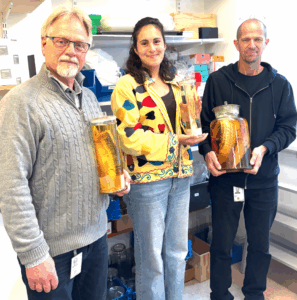
Lucia (middle) holding the smallest juvenile historic Atlantic sturgeon specimen caught from the Göta älv in 1883, proving that sturgeon were historically spawning there. Natural history curators Dr. Kennet Lundin and Dr. Magnus Gelang are also holding juvenile sturgeon specimens from the Göta, which were important for backing up the reintroduction into the same river over a century later.
Lucia also participated in the practical side of reintroduction and got to see and touch her first real live sturgeon! She was surprised by their strength and the sharpness of their scutes. She helped to feed and tag fish, find and deploy receivers for acoustic telemetry, talk to fishers, and even released one sturgeon by hand into the river.
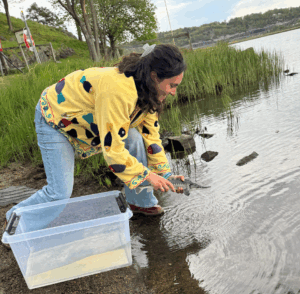
Lucia releasing “Peperoncino”, a juvenile Atlantic sturgeon, into the Göta River. He will be tracked via acoustic telemetry over the next couple years as he migrates out to sea, and hopefully will return to breed in about 15 years.
Lucia will share her reflections with WSCS at the next student presentation day, the UK Sturgeon Alliance (https://www.savethesturgeon.com/), and Gothenburg University’s Sea and Society Seminar Series on 11 June (https://www.gu.se/en/event/the-return-of-the-sturgeon-lessons-from-swedish-waters).
This research exchange would not have been possible without support from the World Sturgeon Conservation Society (WSCS). Lucia would also personally like to thank everyone on the team in Sweden who generously hosted and shared their knowledge and inspiring passion for sturgeon: Linnéa Jägrud, Rikard Åhsén, Mattias Kvarefelt, Kim Almbratt, Joacim Näslund, Gustav Hellström, Emil Lindberg, Erik Fransson, and Jonathan Manning. If it takes a village to raise a child, it takes a team of stubborn, skilled, and strong Swedish souls to raise and release sturgeon!
Lucia plans to use all she learned and the connections she built during this exchange to inform reintroduction planning with the UK Sturgeon Alliance, and greater sturgeon conservation across Europe for the rest of her career.
If you are interested in learning more, Lucia is happy for you to email her: Lu*************@****ac.uk.